


01/10/2026
Modern aviation security is evolving rapidly alongside technology. Artificial intelligence, biometrics, automated screening systems, analytical tools and other digital solutions are becoming an important part of protecting passengers, aircraft, airports and aviation infrastructure.
Security begins not with equipment, but with qualified people. In civil aviation, these are aviation security personnel who screen passengers and their baggage at security checkpoints. In most cases, they are highly trained professionals capable of identifying threats, assessing risks correctly and taking the right action at the right moment.
Behind every system are specialists who develop, configure and monitor it and, most importantly, make decisions in unexpected situations.
For a passenger, screening may appear to be a simple process involving hand luggage and walking through a security scanner, taking no more than five minutes. In reality, those few minutes involve the coordinated work of an entire team of specialists.
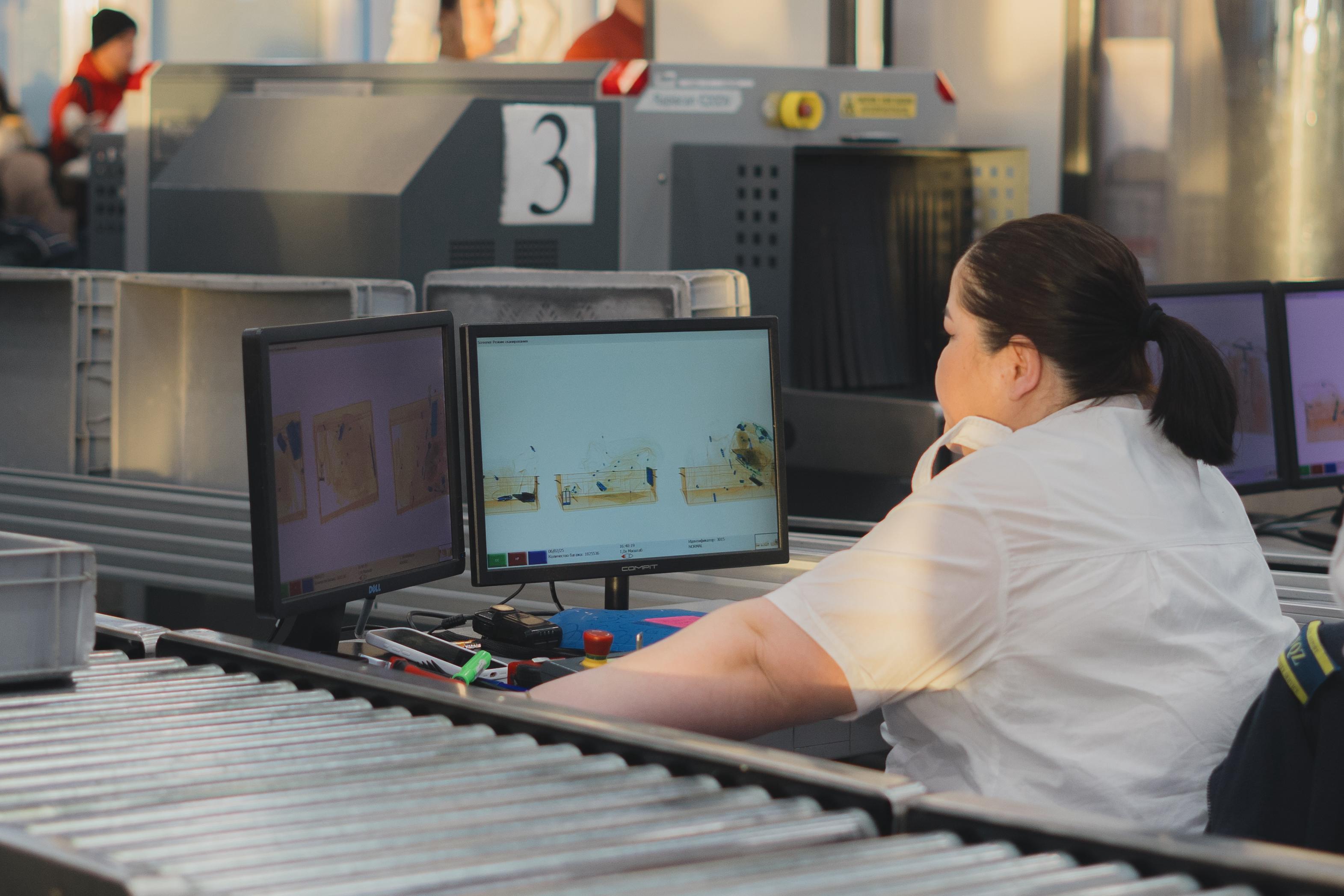
One officer monitors the images on the screen, another checks baggage, a third manages passenger flow, while a fourth decides whether additional screening procedures are required. Together, they create several layers of security control that a passenger normally passes through within just a few minutes, with each specialist having a clearly defined area of responsibility.
The 20-minute rule.
There is an interesting requirement related to X-ray screening equipment operators. They cannot spend hours sitting at a monitor and continuously looking at the screen. ICAO documentation establishes a 20-minute limit for continuous image-screening duties. After that, the operator is replaced by a colleague and moves to another function within the screening area. Later, they return to the screening position with refreshed attention.
Another important part of the job is manual inspection. If baggage is selected for additional screening, the specialist must calmly and systematically establish the reason for the alarm. The process is carried out according to established procedures, rather than simply by “looking at it” and making a judgment.
The same principle applies when dealing with passengers: personnel must follow procedures, communicate appropriately and courteously, while maintaining constant attention to security.
Among the more specialised roles are behavioural profiling officers. They do not look for “suspicious passengers.” Instead, they observe behavioural indicators and a combination of details: changes in behavioural patterns, a person’s reaction to standard questions, communication patterns, movements and other non-verbal signals.
At the same time, a single gesture or look can never, by itself, be considered evidence of a threat. What matters is the combination of indicators and a professional assessment of the situation. To do this, specialists undergo dedicated training and spend hours practising different scenarios.
In other words, an aviation security screening officer is a professional with highly trained attention who takes human factors into account. No technology can fully replace this human expertise.
Maintaining continuous operation of a single screening area at a large airport around the clock may require 12–15 employees. Staffing requirements take into account passenger volumes, flight schedules, hourly passenger flows, baggage volumes and the capacity of screening equipment.
The five people working at a single screening lane are only one part of a much larger system. At the same time, other personnel are working with baggage, access to restricted areas, patrols, video surveillance, response operations, documentation, training and many other functions.
Supported by technology, this “invisible army” of aviation security personnel helps keep civil aviation safe.
Against this background, the development of human resources, practical competencies and a strong security culture will be at the centre of the session “Security Is People: Personnel, Competencies and Culture”, to be held in Astana as part of ICAO Aviation Security Week 2026.
The event will go down in history as the first major global-level event organised by the International Civil Aviation Organization (ICAO) in Kazakhstan and the CIS countries.
For the duration of the event, Astana will become a focal point for global aviation security discussions, bringing together experts to explore the goals and challenges of future security — including what knowledge, skills and professional culture will be needed in a world where technology is becoming increasingly intelligent, while human responsibility remains key.
Registration and programme for ICAO Aviation Security Week 2026:
https://caa.gov.kz/en/aviation-security-week