


25/02/2026
Kazakhstan’s aviation industry continues to demonstrate steady growth across key performance indicators.
This was highlighted during a board meeting of the Ministry of Transport of the Republic of Kazakhstan, attended by First Deputy Prime Minister of Kazakhstan Roman Sklyar, representatives of the Presidential Administration, the Government Office of the Republic of Kazakhstan, heads of subordinate organizations of the Ministry of Transport, and representatives of local executive authorities.
At a meeting in December 2025, the Head of State issued specific instructions and approved a comprehensive three-year development plan for the sector. This underscores the strategic importance of the aviation industry for the country’s socio-economic development, its role in ensuring regional connectivity, strengthening international ties, and enhancing Kazakhstan’s investment attractiveness.
According to the results of 2025, the country’s airports served 31.8 million passengers (compared to 29.7 million in 2024) and handled 173.3 thousand tons of cargo (170.9 thousand tons the previous year). The total passenger traffic of airlines reached 20.7 million people, of which 15.4 million were transported by domestic carriers.
“Growth in industry indicators is accompanied by systematic efforts to ensure safety. Kazakhstan’s compliance rate with international aviation safety standards reached 95.7%, significantly exceeding global and regional averages and placing the country among the top 20 worldwide. Oversight of passenger rights compliance has been strengthened: 27 unscheduled inspections of airlines and airports were conducted, and administrative measures were applied.
Direct access for KazMunayGas-Aero to fuel supplies has been ensured, which allowed the average cost of aviation fuel per ton to be reduced,” said Vice Minister of Transport Talgat Lastayev in his report.
In 2025, 994 inspections were conducted and 960 permits were issued. To strengthen the investigation system, a specialized Aviation Accident Investigation Center was established with the support of the country’s leadership. The objective is to increase compliance with international standards in this area to 80%.
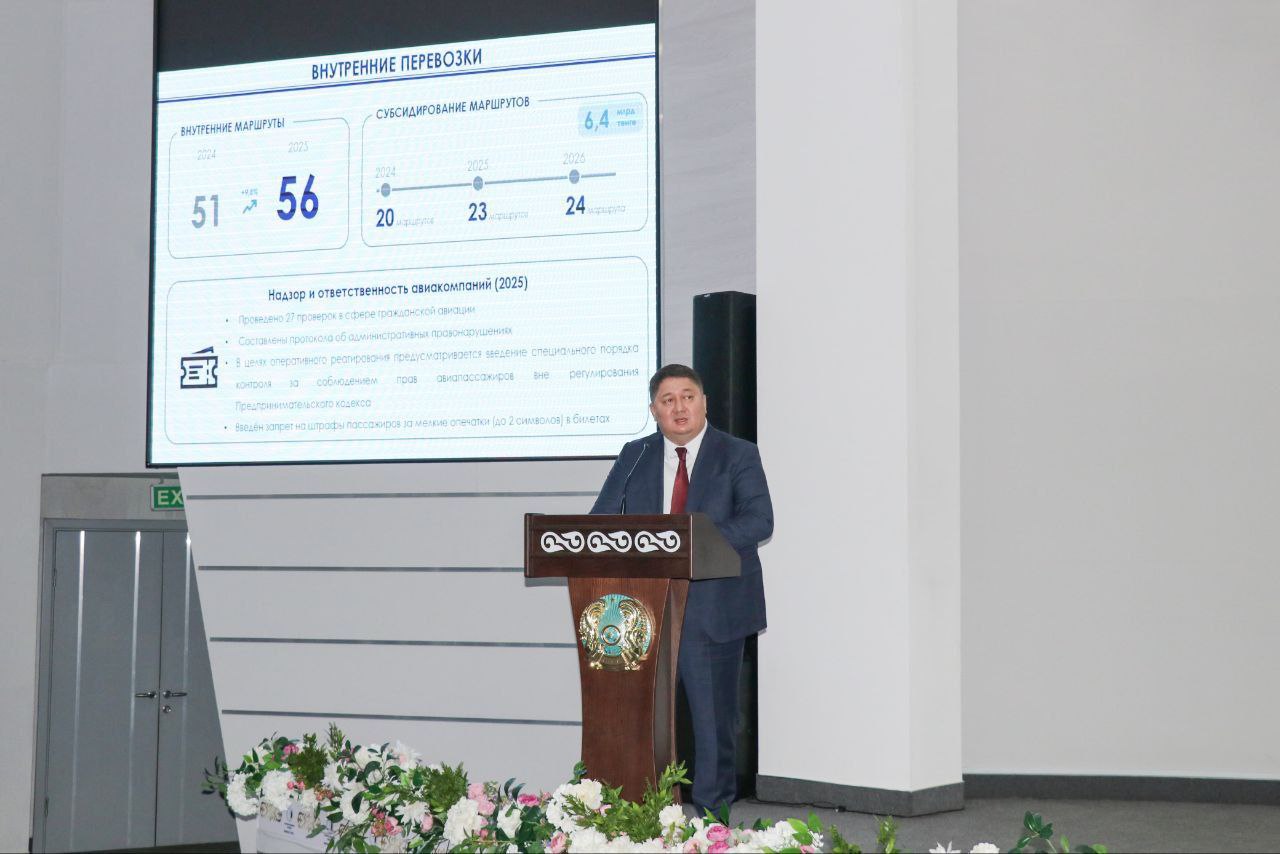
Five Kazakh airlines operate domestic flights on 56 routes.
To ensure transport accessibility for remote regions, a subsidy mechanism is in place: in 2025, 23 routes were supported, serving around 520,000 passengers. In 2026, subsidies are planned for 24 routes, with further network expansion.
Digital solutions are being actively implemented, including automated passport control systems, biometric passenger identification, and the international e-Freight standard, which has reduced cargo processing time from 24 hours to one hour. Work is also underway to develop Urban Air Mobility, including preparation of a regulatory framework for the operation of unmanned aerial vehicles and eVTOL technologies, as well as the creation of vertiports.
The industry currently employs about 25,000 people, with an annual demand for more than 600 specialists. In line with the President’s instructions, a certified civil aviation training center is planned to be established in partnership with an international partner.
During the first official visit to Kazakhstan in July 2025 by the President of the ICAO Council, Salvatore Sciacchitano, a declaration was signed on the joint development of a Civil Aviation Master Plan through 2050.
An ICAO expert mission is expected to arrive in February–March 2026 to begin practical implementation of the project. Kazakhstan also plans to participate in the ICAO Council elections in November 2026.